
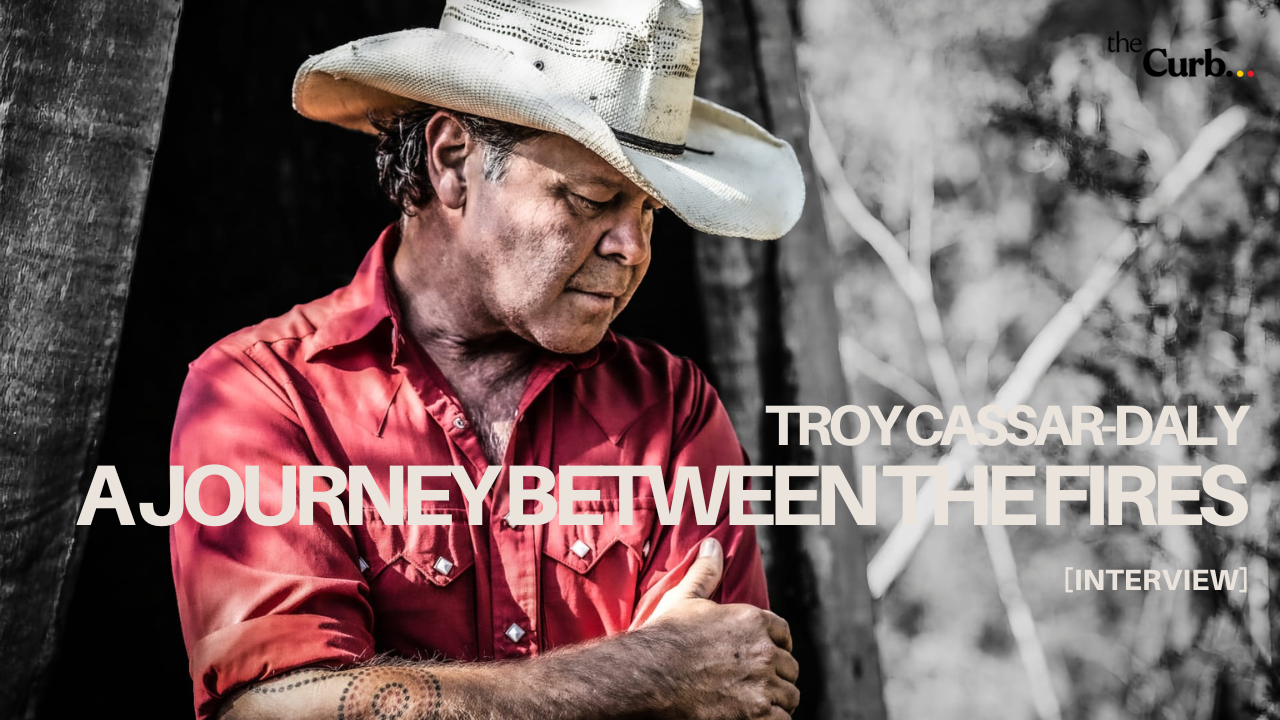
Troy Cassar-Daley one of Australia’s finest country music songwriters and musicians. He’s a familiar face and voice across the nation, with supporters getting to know him through his music and lyrics. His latest album, Between the Fires, is his most personal yet.
Recorded in his mum’s home in Halfway Creek, NSW, after she passed away in July 2022, Between the Fires takes listeners through Troy’s healing process, working through grief, reconnecting with Country and family, and finding a path to continue living without his mum.
There’s a level of vulnerability with a record like this that takes some working through, especially when a lot of the songs were sung in the rooms Troy’s mum called home. Thrown on top of recording this album was the added vulnerability of inviting documentarian Belinda Miller into the process to film the making of the album.
The resulting film, A Journey Between the Fires: Troy Cassar-Daley, is a moving portrait of an artist at work, grieving and growing with each new song. Troy brings in a group of musicians who each honour his work, bringing their own voice to the mix too. In between recording songs, Troy washes himself in the smoke of a fire that they keep burning throughout the making of the album. Just like the nature that hugs the boundaries of his mum’s home, you can smell the smoke and understand the importance of its presence on the songs, with each playing their part in the final tracks.
This is more than just a ‘making of’ doco, it’s an invitation into the world and working process of one of Australia’s finest musicians. When we get to see Troy sitting on the veranda, guitar in hand, processing the songs that he’s making and the meaning of them to his mum, we see a level of openness and vulnerability that I hope we could see more of in the world.
A Journey Between the Fires is screening on SBS On Demand and will be screening on NITV and SBS On Demand on 18 January 2026.
The below interview has been edited for clarity purposes.
Troy Cassar-Daley: I’m trying to work out why on earth I actually did the documentary, because it was a really touchy thing to have cameras around watching this stuff. But I thought to myself, people will never get to see how you make a record. Everyone documents when they make a record for content these days, I understand that, but [documenting] making one where you first became a musician in that very place, [that] was always going to be very special. I thought it was always going to be that personal.
I honestly just felt like it was something I just needed to share, even if I thought to myself [that] it was [just] to show my grandkids one day. I would have been just as happy to have it for posterity, but as it turns out, I had a really great director out here and some beautiful people shooting. I felt like they were family around me. I never felt for one minute that it was uncomfortable.
I certainly got that feeling too. What was the process of saying, ‘Let's follow the making of this album and put it on film’?
TCD: Well, when I came up with the idea of trying to record it here at mum's house, there was a couple of technical phone calls that had to be made. Can we do it? Can people bring in some outboard gear to make it work in this old house that has blackouts every three days? They all said yes, and so did the place that hires the generators. I hired a generator and two engineers, and then the band, and then I thought to myself, I wonder what it'd be like to have a friend of ours come and just direct a little short film while we're doing it, just so we can just capture how much of a privilege it is to be, not only on Country doing this, but at my mum's old house where I first picked up a guitar and I first learned to be a musician.
You really invite people into your mum's home and your home and your story as well. That's such a powerful part of the record, and it's a powerful part of getting to see you and the band working together. I know that the songwriting process is a personal thing too. Throughout your years as a musician, was that invitation that you extend to audiences to join you in these personal spaces something you had to learn? Or did it come naturally?
TCD: Look, I had to learn to invite people to that. You also have to learn to let go of things that you feel you don't really want to share. This in particular was something I really wanted to share, because in the days that we're living in right now, Andrew, where a lot of people are being divided by certain things, I tend to look for the things that unite us, and one of them is music, and the other one is grief. Now they're human touches, right? [And music is] very subjective. You know what your taste of music is, but grief is grief, mate. We all go through it. It's part of life, no matter what you believe in or what your politics are. It's something that unites us. And it was one thing that really made me feel that it was one of those common denominators I really had to share, because everyone has their own journey, and this was just a part of mine.
You're also writing songs about your mum, your past, your future, and we see in those moments where you're recording them, just how emotional the songs are for you. I’m curious then, after having recorded the album and embarked on a tour for it, how have the songs changed for you over time? How does your emotional reaction to these songs change when you're performing it in front of people?
TCD: Well, I haven't rewatched the documentary yet. I watched it for the first time in Tamworth at the beginning of this year, and that was enough for me, because myself and my family, we're losing our shit, [laughs] which is what's bound to happen. I was also on the end of 12 months of touring that record, which was not only incredible to be able to just share those songs and the journey of the whole thing, [but also] for the first time ever, we had I think six or seven brand new songs in a set, and on tour that’s normally really hard to pull off, but these songs were like old friends. No one for a minute said there was too many new songs in the set. They just belonged there. And I've never done that before. Andrew. I've always had maybe two or three of the new ones, and the rest are familiar, but this was particular tour was really themed.
It's the reason I'm sitting here, where I recorded it, talking to you today. Instead of going to America with my wife, I decided I'd come down here to just stop. I mean, I just had a year of festivals, which has been incredible.
I look at those songs, they still mean the same [thing], and sometimes they'll come on in a random playlist, as you go through all the shuffles in my phone, and they mean the same as when we cut them. There's detail in these songs that I think if I didn't get someone to come and capture the doco, and I’m sitting on the veranda here where I am now, breaking down going through a song, people would never see that.
And I never wanted people to see that before this, it was just way too personal. But I thought, ‘Now hang on, there's a human touch thing that I absolutely love to share here on this record. And if I'm going to break down as a 54-year-old man, if people are going to see me lose my shit, they're going to see it. And I don't care what anyone thinks, but I think they need to know that there is a humanity part of making a record that has to be seen.
I visited a friend of mine who's now a TAFE chef person who I went through a course with. Some of the young chefs have been doing it tough and not knowing where they fit in the world, you know. And I sang them a song, and it meant the same when I sang it to them in that TAFE college as it meant when I was sitting there crying on the documentary. I remember it was one of the things that I was going to get him to take out, and I was going to say to my director, ‘Do we really need me falling into a heap?’ And she goes, Yeah, yeah, we do, because it's part of the process of what you're going through.’
Showing it also reinforces that it's okay to break down into a heap sometimes. It's okay. It's normal.
I'd love to talk about your mum's kitchen table for a moment, because in the discussions about her home and what it means to you and your family, there's also something particularly important about a kitchen table in a home. It's a communal place. People sit there and meet. It's where they eat food and talk. Are there any particular memories of sitting around your mum's kitchen table that felt integral to creating the record?
TC-D: Yeah, it was a bit of a great place to test songs on my mother. It was really hard moving everything around, because everything was sort of where it was when she left it. She used to do a crosswords there. But if ever I was trying out a new song, it was always across the table to mum on that old wooden kitchen table. I think the reason that it was so special to do this record here is the fact that, of course, I never had a chance to try these new songs on her, but it almost felt like I was as I was recording them. So it made such a lot of sense to me to not only record the record here, but it did feel like I was sharing them for the first time with my mother, as I would have over the last 25-30 years of writing. It was a real natural feel for me to sit on the veranda and play them for the band for the first time, but it also felt like mum was hearing them for the first time as well.
That's beautiful. I want to talk about inviting the rest of the band into your creative process. When you first played the songs to them, it’s almost as if you're inviting them to add their voice to your memories and stories. And that, in itself, can be a bit difficult too, as we see during moments where you need to take a bit of a step outside and go to the fire and reconnect with the fire for a moment. As a creative person, how do you go through that process of inviting band mates into your creativity, saying ‘add your voice to my story?’
TC-D: With each phone call that I made to each member of the band, it was important that I hand picked the people who would be able to add something that I thought was going to be appropriate. They're people that I've loved and respected for a long time.
The bass player, Jeff McCormack, I've made many records with as an engineer and bass player, so I trusted his judgment, and he brought some amazing stuff. The drummer, Scott Hills, I trusted his judgment as well, because I had him in my band at different times. The young guitar player, Michael Muchow, I've known him since he was a child, he’d come to gigs and got me to sign his guitar, that sort of thing.
Then there was the steel player, Ollie Thorpe, who has played rhythm guitar for Ian Moss for years, but I heard he was a really good basic steel player. I said, ‘Well, that's who I need.’ We loved his steel playing so much, Andrew, that he was on everything. I just didn't let him rest. I want steel all the way through this, it just tends to be the theme of this record. And he's a very handy guitar player too, yeah?
We had Michael Muchow sitting out in the back room near the dunny, doing his parts out there, and it was just so beautiful to hand these songs over to each and every one of them. They'd listen to the demo, which was always going to be rough, but it was done in my shed at home, and then they’d take it to the next level, where they add their little bit of magic.
It was one of those things, like trusting a horse before you sit your ass on a saddle. Every time I did it, it never felt like I was taking a chance handing these ideas and these things that I'd written here over to the band.
The presence of nature on the album and in the film is welcome. The scenes of you reconnecting with certain trees in particularly struck a chord with me. There's one song which I think has probably stuck out the most for me, which is Dreams, which has the presence of the black cockatoos and the flow of nature as it connects to the music. Just as we hear nature in the recordings, we can also hear the house too. How important was it to have nature embedded in songs like Dreams?
TC-D: Well, I don't even know why I had the foresight to record the different birds around the house as I was writing the songs on my phone. But one night, I was laying here and the curlew was singing out. Now, we've never had a curlew out at this house and to be honest, it scared the shit out of me Andrew. I was sleeping in my old boyhood room there, so I cracked the window, put my phone up there, and just caught the curlew singing at the front of it.
And then I was leaving one afternoon, and I just finished mowing and all that through the week, and as my goodbye, about twelve black cockatoos flew straight over the house as I was just about to pack the car. So I grabbed the phone once again and recorded them coming over. It almost feels like they're in the house with you. You can hear them in the house almost.
When Dreams was written, I said to my engineer and producer, ‘Look, can I just please get these birds that I've recorded on the Country on the top and tail of this song? Because it's a really, really personal song, and it's something that I think I need to have on there.’ And it just felt so much more special with them giving you the intro and then the goodbye at the end.
The fella that did the audio for the documentary said he's always been trying to use his technology to get rid of bird noises in documentaries, and [this is] the first time he's turned them up. I thought that was such a beautiful thing to hear, because that's what draws me back here is the sound of the Country. The Country actually feels like it's speaking to me.
I felt like I was transported there. It's immersive in a way that I think that we can often take for granted. It's through hearing sounds that and getting to see the imagery in the film, and then hearing what it does to you as a singer, which means so much. Getting to experience your stories through these songs and through the film has meant a huge amount. Thank you Troy for opening up to people this way.
TC-D: What a pleasure mate. The messages that I've got from random people through to people who know me has been so special. Like I say, I'm not as heady in grief, obviously, as I was when I was making this record, but I am still in awe of what the Country does. That's why I'm back here at the moment. It's been the best thing for my mental health, and it's been the best thing, I think, from my heart as well, as far as it's healing.
Andrew, like I say, it's been such a process, and I would say to anyone, grief is your own journey. There's no date that it switches on and then switches off. And I wish there was, because I’d just find the switch and turn it off, but you just have to pretty much roll with it. You can't go around it or under it or over it. You’ve got to go through it.
That's beautiful. Thank you.
TC-D: Thanks mate. Thanks for your time, brother. I really appreciate it.